
More Housing Doesn’t Raise Your Rent.
The most durable myth in local housing politics makes housing more expensive.

I get to participate in a lot of public hearings where housing is on the agenda and local residents have shown up to share their concerns. There is one particularly heartbreaking myth that I keep hearing and hope to dispel here.
A developer proposes new apartments or townhomes in a neighborhood. Someone stands up at the microphone and says: this development will raise our rents and push people out. Several people in the room nod in agreement. Some even exclaim their agreement out loud. The result is that the Planning Commission or the Town Council begins to question whether this development is the right thing. They delay. Or they ask for more studies. They might say that they would support the development if only the housing were more affordable. But the Council does not offer financial support to help achieve that desired affordability. And members of the community go home feeling like they protected the neighborhood.
It’s a powerful story. It feels good. But the evidence suggests this pattern is making housing more expensive and its harming local neighborhoods.
We now have abundant and rigorous research to demonstrate the impact of new housing supply on affordability in lower income and middle income neighborhoods.
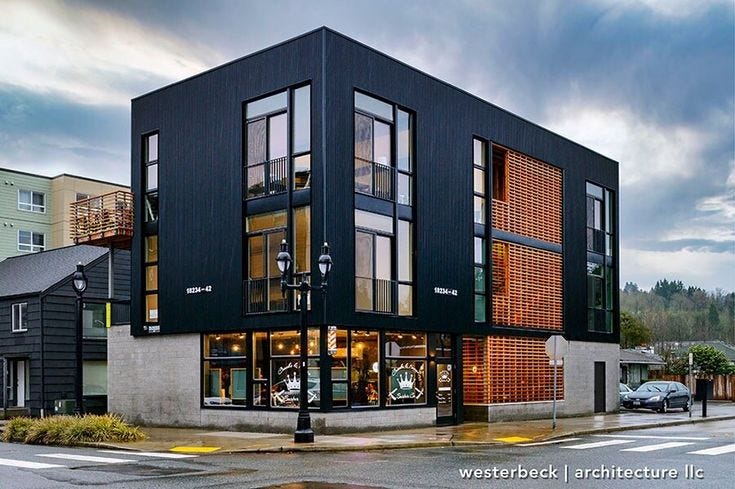
Small scale infill on an empty corner lot creates housing without displacement.
The Research
The clearest recent summary comes from Vicki Been, Ingrid Gould Ellen, and Katherine O’Regan of NYU’s Furman Center, in a 2024 paper with the very on-the-nose title “Supply Skepticism Revisited.” They set out to test the skeptic’s core claim (that building market-rate housing won’t slow rent growth) against the best available causal studies. Their review points to four findings:
More supply reduces rents, or slows rent growth, across a region. This is the well-established one.
In many cases, new construction slows rent growth in the immediate surrounding neighborhood, too, not just the metro at large. This is the exact opposite of the fear many people have that a new building in their neighborhood will raise rents in nearby buildings.
New supply has not been shown to increase the displacement of lower-income households. It gets associated with markers of gentrification, but association and causation are not the same thing, and the displacement effect people fear simply doesn’t show up in the data.
New housing sets off a chain of moves. A household moves into the new building, vacating an older unit, which someone else moves into, and so on down the price ladder. Those “moving chains” open up homes for people across the income spectrum, including renters far below the price point of the new construction.
None of this is fringe. It lines up with a growing set of place-based studies. Kate Pennington’s work on San Francisco and the Urban Displacement Project’s analysis of new market-rate construction in Los Angeles and San Francisco all point to new supply easing displacement pressure rather than driving it.
If you want a simplified summary of the research, read Jerusalem Demsas. Across her housing writing for The Atlantic, collected in On the Housing Crisis, she has spent years dismantling the idea that new construction is the villain. Her essay “The Real Villain in the Gentrification Story” makes the point that has stuck with me most: the villain isn’t the new building in a changing neighborhood. It’s the wealthy, exclusive neighborhood that built nothing at all. When affluent areas use their political muscle to block housing outright, the households who would have lived there don’t disappear. They go compete for homes in the neighborhoods that couldn’t mount the same defense. What arrives in those neighborhoods is demand, and it arrives whether or not anyone builds anything. The new apartments are a response to that pressure, not the cause of it.
Which points at the actual problem: we have been asking a handful of neighborhoods to absorb a region’s entire growth, and then blaming the buildings and their developers for the results. We want housing to be more affordable. We can achieve that affordability over time by building enough new homes to serve the entire community.
Austin is the case study everyone now cites. According to a March 2026 analysis from the Pew Charitable Trusts, the city added 120,000 homes between 2015 and 2024, a roughly 30% increase in its housing stock. Over that same stretch the citywide median rent fell about 16%, from $1,546 in December 2021 to $1,296 by January 2026. Austin went from renting 15% above the national median to 4% below it, and it did that while the city added population. That is what supply looks like when a city lets it happen.

An ongoing housing boom in Austin, Tx has proven to reduce rents across the City.
Demsas’ deeper point is that blocking market-rate housing to “protect” a neighborhood is one of the most reliable ways to make that neighborhood less affordable, not more. When we block new housing in existing neighborhoods, we guarantee that more households will compete for the scarce options already available. That pushes prices up.
On Rent Control
Many of the same advocates who fight new development will, in the next breath, champion rent control or rent stabilization. And I understand the instinct. It comes from a real place of wanting to shield renters from brutal, sudden increases.
But look closely at what rent control actually delivers. Rent control does not reduce the underlying cost of housing in a city. What it does, for the units it covers, is slow the rate at which rents rise and give existing tenants stability. That’s the mechanism people are really asking for: protection from runaway rent growth. (The trade-offs are well documented too: rent control tends to push rents up in the uncontrolled part of the market and discourages new construction, which is why economists are so wary of it.)
Now compare that to the supply research. Slowing the growth of rents is exactly what building more housing does, except it does so market-wide, for renters who will never set foot in a rent-controlled unit, and it does so by adding homes to the stock instead of shrinking it.
Rent control and new supply are aiming at the same target: minimizing rent growth. One does it by rationing a fixed and shrinking pool of housing for only a handful of people. The other does it by growing the pool. If you accept the goal behind rent control, you should also accept the goal behind building more housing supply. The problem is that so many people are afraid of the change that comes with building.
Asterisk*
New market-rate housing is not a substitute for dedicated affordable housing, vouchers, or public investment. We need all of those as well.
Austin Texas is proving the both/and scenario. Pew Charitable Trusts has broken the 2023 to 2024 rent declines out by building class, and the pattern ran opposite to what the skeptics predicted. Class A luxury units fell 2.6%. Class B fell 5.9%. Class C, the older non-luxury buildings that house lower-income renters, fell 11.4%, the largest drop of any large metro in the country. The relief was biggest at the bottom of the market, which is where the filtering theory says it should show up and where critics said it never would.
“Supply won’t fix everything” is a very different claim from “supply makes things worse.” The first is true. The second is the myth that we have to keep pushing back against because it keeps killing or diminishing projects in places that desperately need more housing and more investment.
What this means for our neighborhoods
Our firm is based in West Michigan, where the housing math is not subtle: we are tens of thousands of units short, and the shortage is what’s driving rents and home values beyond the average household’s ability to afford them. When we block housing in the name of affordability, we get neither the housing nor the affordability. We get scarcity. It shows up as families priced out of good school districts, young workers forced to leave the region, and seniors who are trapped in homes that no longer suit their abilities.
Research alone won’t make the next public hearing any easier. The story of the greedy developer raising your rent is emotionally satisfying in a way that “moving chains and regional filtering effects” will never be. But we need to get much better at explaining how the housing system actually works, and at talking with the broader public and with housing advocates about what is genuinely possible when we work in alignment with the data.
Sources: Been, Ellen & O’Regan, “Supply Skepticism Revisited,” Housing Policy Debate (2025); Jerusalem Demsas, housing writing for The Atlantic, collected in On the Housing Crisis: Land, Development, Democracy (2024);
Pennington, Kate, “Does New Housing Supply Cause Displacement”, 2020
Mast, Evan, “New Construction Makes Homes More Affordable - Even for Those Who Can’t Afford The New Units”, W.E. UpJohn Institute
Diamond, Rebecca, “What Does Economic Evidence Tells Us About the Effects of Rent Control?”, Brookings
More details needed about the moving chains. This article (and others) base a lot of ideas for rent reduction on the concept that a moving chain occurs which opens up units from new supply. What seems to be missing is where the money comes from? A new apartment that comes online at market rate is more expensive than an existing unit in the market. The addition of a new (more expensive) apartment doesn’t create more money to afford it. Analysis to start the migration process into new housing must include what is happening with market demand. Has income increased? Population density increased? Something must be happening
Having lived and worked in places where there was both extensive building and increasing rents, I know that these studies do not apply everywhere, all the time. It is the ecological fallacy written up in the textbooks. There is no guarantee that large aggregate statistical studies will represent any individual case. I think these studies probably do represent certain, just not all, cases, but whether they do or not, I know that sweeping generalizations win no arguments at town hall. People act based on lived experience. Statistics offer no short cuts to the hard work of persuading folks that building housing just might be in their interest, if they think about it.