
Six Steps to Community-Supported Growth: How to Avoid the Backlash

Fear of change is natural. When residents hear about new development in their neighborhood, their minds often jump to worst-case scenarios: traffic gridlock, overcrowded schools, parking nightmares, buildings that don’t fit, and a neighborhood that no longer feels like home.
But here’s what we’ve learned from communities that have successfully navigated growth: the backlash isn’t inevitable. When residents feel ownership over the vision, when the process respects their input, and when the results reflect their values, opposition transforms into support.
Here are six implementation steps that work.
1. Craft a Clear Neighborhood Vision with Specific Design Patterns
Vague plans invite opposition. When residents don’t know what’s coming, they imagine the worst. The solution isn’t less community input—it’s more, channeled into something concrete.
A design charrette brings residents, business owners, property owners, and design professionals together for an intensive multi-day workshop. Unlike traditional planning processes with endless meetings and dwindling attendance, a charrette creates momentum. Participants don’t just comment on someone else’s plan—they help create it.
The output should be specific: not “we want walkable neighborhoods” but illustrated building types, street cross-sections, and design standards that show exactly what future development will look like. When residents can see renderings of buildings that fit their community’s character—roof pitches, materials, setbacks, landscaping—abstract fears become concrete conversations.
Critically, the vision must be economically feasible. Beautiful renderings mean nothing if the buildings can’t actually be financed and built in your market. The charrette process should include developers and builders who can reality-check the economics. A vision that sits on a shelf because nobody can make the numbers work is worse than no vision at all.
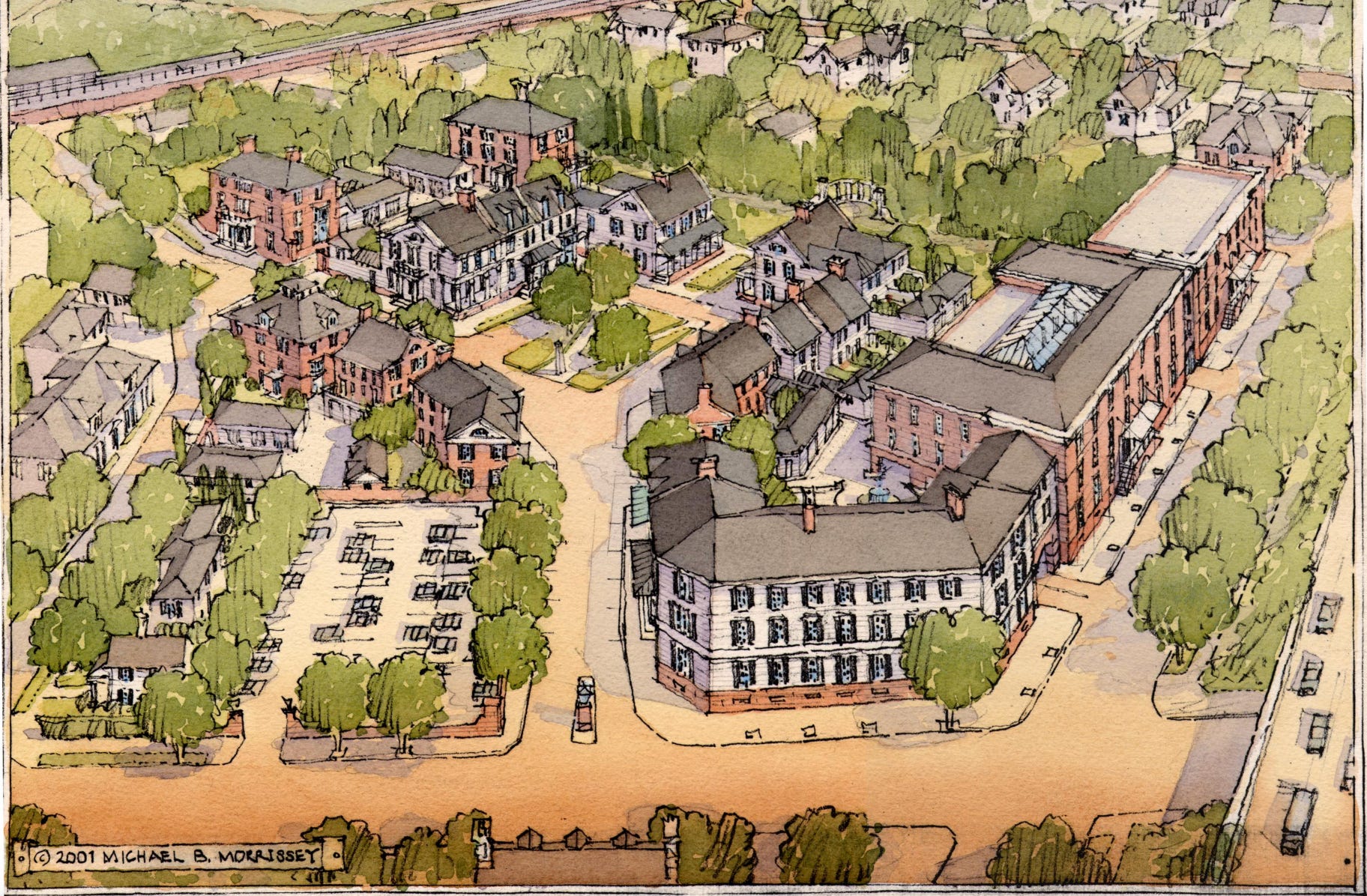
Source: Robert Orr & Associates, Massengale & Co LLC, and Michael Morrisey
The goal is a strong sense of identity rooted in place. What makes your community distinct? What architectural traditions deserve continuation? What patterns of streets and blocks have worked well historically? The vision should feel like it belongs to your town—not something imported from somewhere else.
2. Amend the Master Plan and Zoning Ordinance to Make Implementation Easy
A vision without regulatory teeth is just a wish. The community’s hard work during the charrette process must be codified into actual policy.
This means updating your master plan to reflect the vision, then aligning your zoning ordinance so that development consistent with the vision can happen by right—without public hearings for every individual project.
This is where many communities stumble. They create a beautiful vision, then leave in place a zoning code that makes that vision illegal to build. Or they require discretionary approval for every project, which means every project becomes a new battle.
By-right development isn’t about removing community voice. It’s about moving that voice upstream—into the visioning process and the code itself—rather than relitigating the same questions project by project. When the community has already decided what they want through the charrette, individual projects that match the vision shouldn’t need to prove themselves all over again.
Form-based codes are particularly effective here. Instead of regulating primarily by use (residential vs. commercial), they regulate by building form—ensuring that new construction fits the physical character the community has defined. A project that meets the code’s standards for setbacks, height, facade treatment, and relationship to the street can proceed without discretionary review.
The result: developers know what’s expected, staff can approve conforming projects administratively, and residents can trust that what gets built will match what they envisioned.
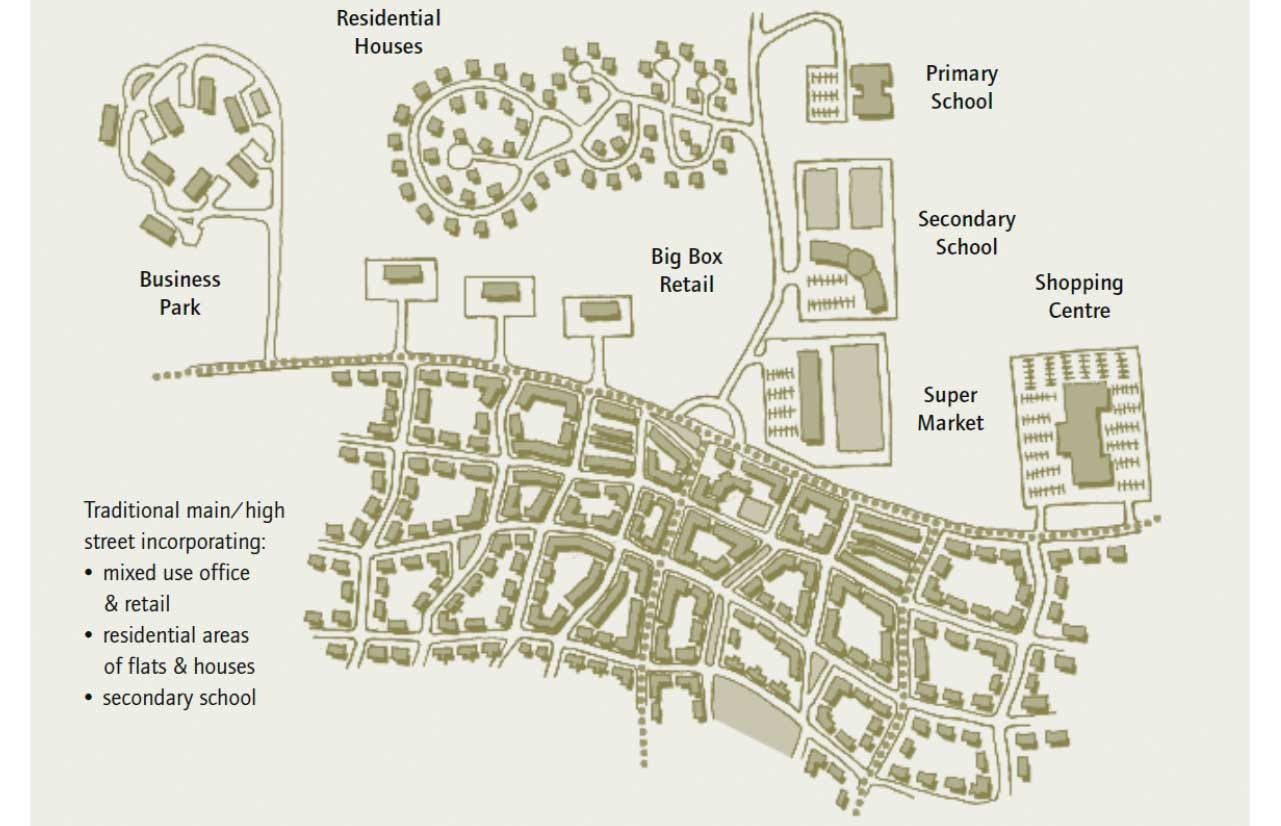
Many communities say they want the development pattern on the lower half of this drawing in their master plans, but their zoning laws require the patterns on the upper half - land uses are all separated and surrounded by massive parking and green space requirements, each one planned in isolation from the neighboring properties.
3. Invest in Shared Infrastructure That Represents Community Priorities
Private development alone doesn’t make a neighborhood. The public realm—streets, sidewalks, parks, plazas, trails—creates the connective tissue that makes places feel like communities rather than collections of buildings.
When a community invests in high-quality shared spaces, it sends a signal: we’re serious about this vision, and we’re putting public resources behind it. A new pocket park, a streetscape improvement, a trail connection—these visible investments build confidence that change is being managed thoughtfully.
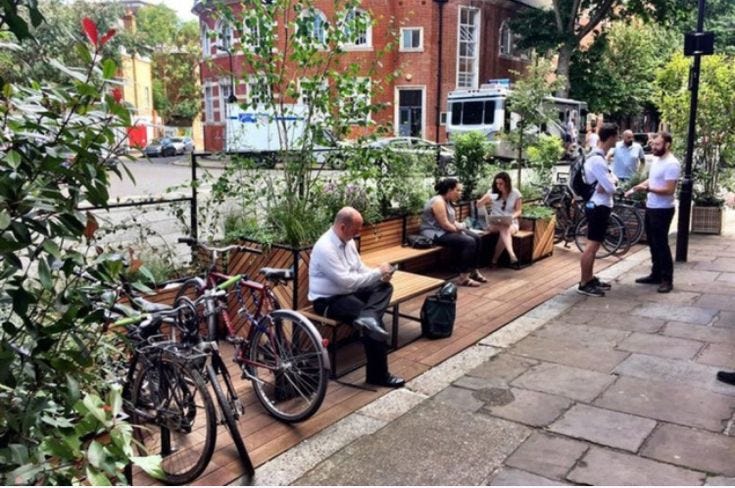
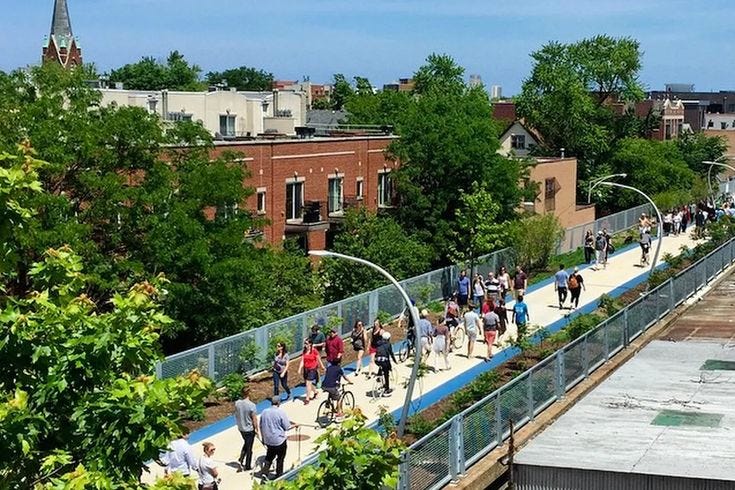
More importantly, public investments create shared spaces accessible to everyone. When growth brings new residents, existing residents benefit from amenities they couldn’t have afforded alone. The new trail isn’t just for the people in the new apartments—it’s for everyone. The improved streetscape serves the whole community.
This is also where community priorities become tangible. If the charrette identified walkability as a core value, invest in sidewalks and crosswalks. If green space was emphasized, prioritize parks and tree canopy. If gathering places matter, create plazas or improve the town square.
Public infrastructure investment demonstrates commitment to the vision and creates shared benefit that can help existing residents see growth as an opportunity rather than a threat.
4. Support Small-Scale and Local Developers
Who builds the vision matters as much as what gets built.
Large outside developers often trigger community resistance almost automatically. They’re seen as extractive—taking profits out of the community, indifferent to local character, accountable to distant investors rather than neighbors.
Small-scale local developers are different. They live in the community. They have relationships with neighbors. Their reputation depends on getting it right. They’re building wealth locally rather than extracting it.
The more your community can cultivate homegrown developers to execute the vision, the better. This might mean:
Technical assistance to help first-time developers navigate permitting and financing
Pre-approved building plans that reduce design costs for small projects
Streamlined permitting that doesn’t require expensive consultants and lawyers
Connections to financing through local banks, CDFIs, or community loan funds
Education programs that teach the basics of small-scale development
When the person building the new fourplex is someone’s neighbor—someone who goes to the same church, whose kids attend the same schools—the project feels different than when it’s a faceless corporation from out of state.
Local developers also tend to build incrementally, one project at a time, which gives the community time to adjust. A dozen small projects spread across the neighborhood over several years is far less disruptive than one massive development all at once.
5. Celebrate Early Successes and Clearly Articulate the Benefits
The first projects that implement the vision are crucial. They demonstrate that the process works—that what the community envisioned can actually be built, and that it looks and functions as promised.
Don’t let these successes go unnoticed. Celebrate them publicly:
Host ribbon cuttings and open houses
Feature projects in local media and municipal communications
Create before-and-after documentation
Share stories of the people who now live or work there
And be specific about the benefits:
“This development added 12 families to our community—that’s 8 more kids in our elementary school.”
“The new businesses created 15 local jobs and generated $XX in annual sales tax revenue.”
“Property tax revenue from this project will fund trail maintenance for the next decade.”
“Three of the new units are occupied by teachers who work in our schools but previously couldn’t afford to live here.”
Abstract benefits don’t persuade skeptics. Concrete benefits do. When residents can connect new development to specific outcomes they care about—school enrollment, local jobs, park funding, workforce housing—the value becomes real.
Early successes also build developer confidence. When local builders see that projects consistent with the vision move through approvals smoothly and lease up quickly, more of them will participate. Success breeds success.
6. Continuously Connect New Development to the Community’s Vision
Memory fades. The excitement of the charrette dims as months and years pass. New residents arrive who weren’t part of the original process. Elected officials turn over.
Successful communities don’t let the vision become a dusty document on a shelf. They continuously remind residents that new development is a direct result of their input and feedback.
When a project comes forward:
Reference the charrette: “This proposal implements the mixed-use building type that residents identified as a priority during our 2023 community visioning process.”
Show the connection: Display the original vision drawings alongside the current proposal so people can see the through-line.
Credit the community: “This is what you asked for” is a powerful message. It reminds residents that they shaped this outcome.
When projects are completed:
Tell the story: “Two years ago, our community came together to envision this neighborhood’s future. Today, we’re seeing that vision become reality.”
Invite participation: Hold anniversary events at the charrette site. Update the community on implementation progress. Keep the vision alive as a living document rather than a historical artifact.
This ongoing communication serves multiple purposes. It reinforces that the process was legitimate and resident-driven. It helps newcomers understand the context for what’s being built. It holds officials and developers accountable to the vision. And it builds institutional memory that survives staff and leadership transitions.
The Pattern That Works
These six steps aren’t independent—they reinforce each other:
A clear vision gives residents confidence that change will reflect their values. Aligned regulations make that vision achievable without endless fights. Public investment demonstrates commitment and creates shared benefit. Local developers build trust and keep wealth in the community. Celebrated successes prove the model works. Continuous communication maintains momentum and accountability.
Communities that follow this pattern don’t eliminate all opposition—some resistance to change is inevitable. But they transform the default from “fight every project” to “support projects that match our vision.”
The difference between communities that grow well and communities that struggle isn’t whether they face challenges. It’s whether they’ve built the foundation—the shared vision, the aligned regulations, the trusted process—that lets them navigate those challenges together.
That foundation starts with bringing your community together to answer a simple question: what do we want to become?
The answer, built collectively and implemented consistently, is the antidote to backlash.
Thank you for updating the image for Southport Green and adding the credits for Robert Orr & Associates, Massengale & Co LLC, and Michael Morrisey. Here's a preliminary sketch when we were trying to convince the developer to buy the empty parking lot you see in the later sketch: https://photos.massengale.com/wp-content/uploads/Aerial.jpg. Here's the link for more Southport Green images: https://photos.massengale.com/southport-green/.