
Understanding Your Community’s Housing Future
The Power of a Housing Needs Assessment

If you’re a local community leader, chances are very high that you’ve heard the anecdotes from friends, neighbors, and employers about local housing challenges. The stories often sound something like this:
An elementary school teacher commutes forty-five minutes each way because she can’t afford to live anywhere near her school. And the school principal is having a hard time hiring for two more open classrooms because the district can’t afford to pay enough that young teachers can live close by.
A retired couple, ready to downsize after the kids have moved out, discovers there’s nothing smaller available in the neighborhood they’ve called home for thirty years—just more large single-family houses like the one they’re trying to leave. They have plenty of equity but they still feel trapped in a house that no longer suits their needs.
A young family stretches to pay the rent on a one-bedroom apartment, their toddler’s crib wedged into the corner of their bedroom, waiting for something bigger to open up that doesn’t blow their budget.
These stories are true in most communities across North America today. There is very little question about whether or not some households are struggling. However, these anecdotes do not explain the depth or breadth of the issue. They are snapshots that are relevant, but not the whole story.
If your community is ready to gain a better understanding of how many households are stretched thin, how many households are trying to move in, and what the variety of housing needs looks like - at every price point - a housing needs assessment is your next step.
What Is a Housing Needs Assessment?
A housing needs assessment is essentially a comprehensive inventory and forecast of a community’s housing situation. It examines who lives in your community today, who works in your community, what kinds of homes exist, what’s missing, and what will be needed in the years ahead.
Think of it as a community checkup that answers fundamental questions:
Do we have enough starter homes for young families?
Are seniors aging in place because they want to, or because there’s nowhere else to go?
Are essential workers—teachers, nurses, firefighters—able to live in the communities they serve?
A thorough assessment typically examines several dimensions. It looks at demographic trends, including population growth, household size changes, and age distribution shifts. It analyzes the existing housing stock by type, age, condition, and price point. It evaluates affordability by comparing local incomes to housing costs across rental and ownership markets. And it projects future demand based on employment trends, migration patterns, and household formation rates.
How Assessments Reveal Market Dynamics
The real value of a housing needs assessment lies in what it reveals about the gap between supply and demand.
In Ottawa County, Michigan we hired Bowen National Research to conduct our first housing needs assessment in 2018 and discovered that the community had a significant shortage of rental options priced affordably for middle-income households. At the time, we needed a whole lot more studio and one-bedroom apartments for all the young professionals who were taking jobs in manufacturing, engineering, education, and the medical fields.
What we learned was that because the region had not built enough rental housing over the previous two decades, these new young professionals who were entering the market were now outcompeting families who had been renting in the community for years.

While there was extraordinary demand for small-scale apartment options like this studio unit, there was almost nowhere in the County where it was permitted to be built.
Until that point, most of our rental product was two-bedroom apartments and median rent had been steady at around $700 or $800 per month with average increases of roughly 2% per year. That older rental housing was working out okay for young families who were saving up to buy their first home. Some of it was getting a little tired, but property owners were generally keeping up maintenance and care for the properties.
However, from 2012 - 2018, there was fairly significant job growth in the region with a large share of those jobs going to young, single adults. These were often college grads with technical degrees or four-year degrees who were making $50k - $60k per year AND they were perfectly happy to share a two-bedroom apartment with a friend.
Think about this for a minute. A single mom earning $30,000 per year could just barely afford that two-bedroom apartment at $800 per month. And now she has to compete with a couple of 25-year olds who are earning $50k per year - EACH!
As you can imagine, local rental property owners quickly understood this dynamic and their rates began to rise. The same apartment that was $800/mo in 2015, rented for $1,100 in 2018.
These young college grads could technically have afforded $2,500 per month in rent with their combined incomes, but there weren’t any nice new apartments available. Just the same old stuff from the 80s and 90s. What other choice did they have?
We Get the Housing We Zone For
At the time, I was leading an organization called Housing Next - a non-profit initiative of the local United Way that was dedicated to solving housing challenges for the workforce and ALICE population.
As soon as we had the data from our housing needs assessment, we were able to begin unpacking why there was such a shortage of rental options available. If we had thousands of young people earning $50k per year who wanted to rent something in the region, why wasn’t the market responding to that demand and building it? Why were these young college grads competing for older, family-oriented apartments?
These questions were truly perplexing to a lot of local leaders at the time. But as we then dug into the local ordinances across the county, we began to understand. We created the following two slides to illustrate what was actually going on back in 2018.
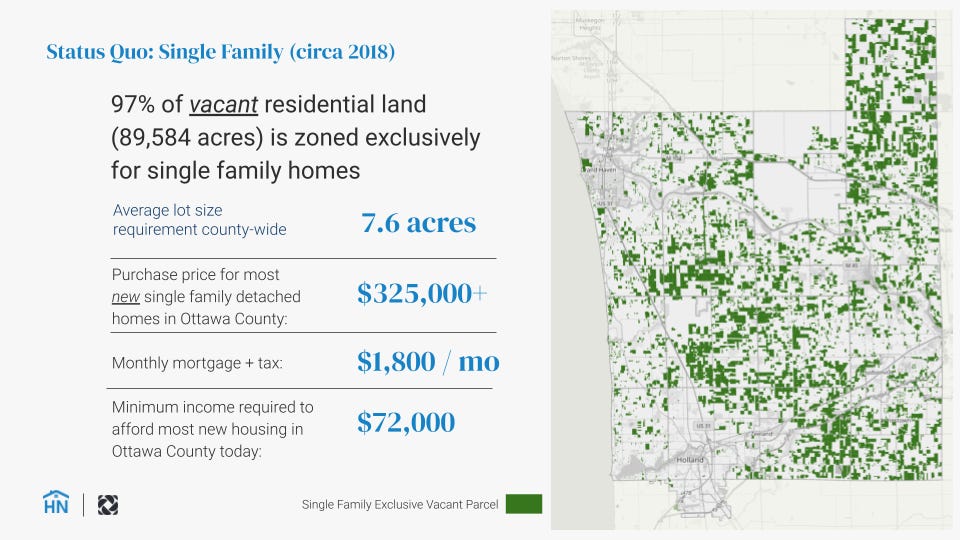
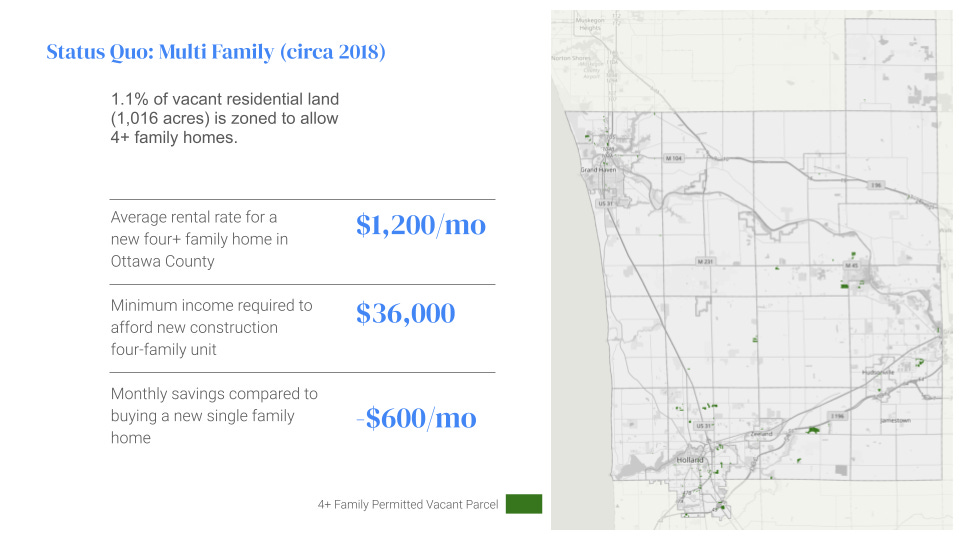
Looking back at these numbers, prices in 2018 seem astoundingly affordable. But at the time, we could all see that a crisis was brewing. Locally, 40% of renters were cost-burdened and that number was growing. In a region where we had long taken great pride in being one of the most family-friendly places in North America, many local families were being priced out.
The worst part was, this was a crisis of our own making. Local employers were paying good wages. But our standards of development were boxing out many of the households we needed most to keep our community running. Grocery store managers, day care workers, and most of the service industry could no longer afford to live here.
So, because we had a housing needs assessment in hand that told us where we were falling short, we began a multi-year campaign to encourage local units of government to amend their zoning ordinances and allow more rental options. And, we knew enough about local land use infrastructure to understand that we didn’t need massive rezonings of entire neighborhoods - we needed about another 1% of the land area to be available for more housing options. We also knew that it would make the most sense if we focused on places that were already close to existing community amenities, infrastructure, and jobs centers.
Skipping ahead a few years, we expanded to a multi-county regional focus and we were able to catalyze more than 6,500 new housing units that would not have been legal to build prior to our efforts. We also leveraged the ARPA funds in two counties to establish an $82M revolving fund focusing on workforce housing and child care.
Hooray for us!
But not so fast. Because we care about the data, we renewed our housing needs assessment twice in the intervening years. The most recent housing needs assessment revealed that we had indeed done the work necessary to solve for adequate rental options for the workforce. That if we kept pace with what we had started, our local market would be able to fully catch up and we would find some equilibrium in the market.
However, while we were focused on creating more rental options for our workforce, the homeownership market skyrocketed. Our post-COVID housing needs assessment revealed that we had essentially lost ALL of our starter home stock. There was no longer anything priced below $250,000 and most new homes being built were priced closer to $500,000.
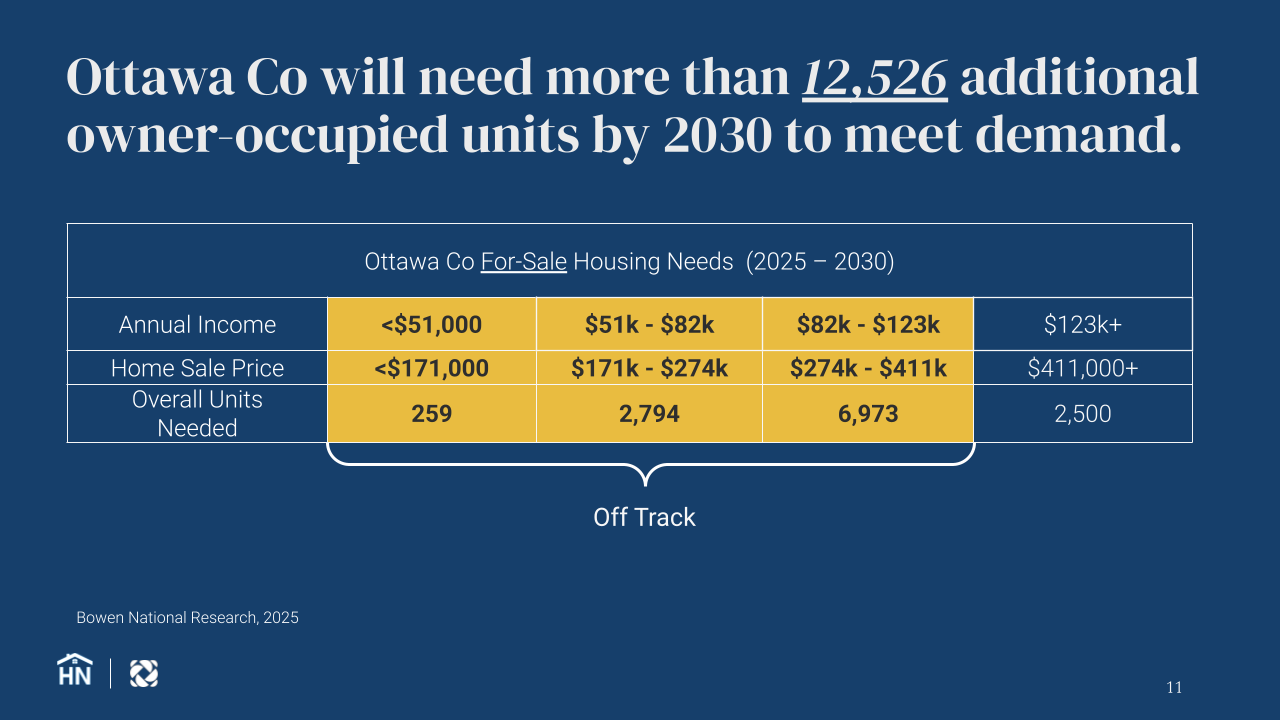
So, once again, we dove into the data and discovered that the vast majority of homes being built were 2,400 square feet or larger and most of the land zoned for new homes required large lots of an acre or more - even when served by public infrastructure.
This is a problem that our local communities are still in the process of tackling, but Ottawa County recently released its Small Footprint Homes Initiative - an effort to demonstrate the power of small.
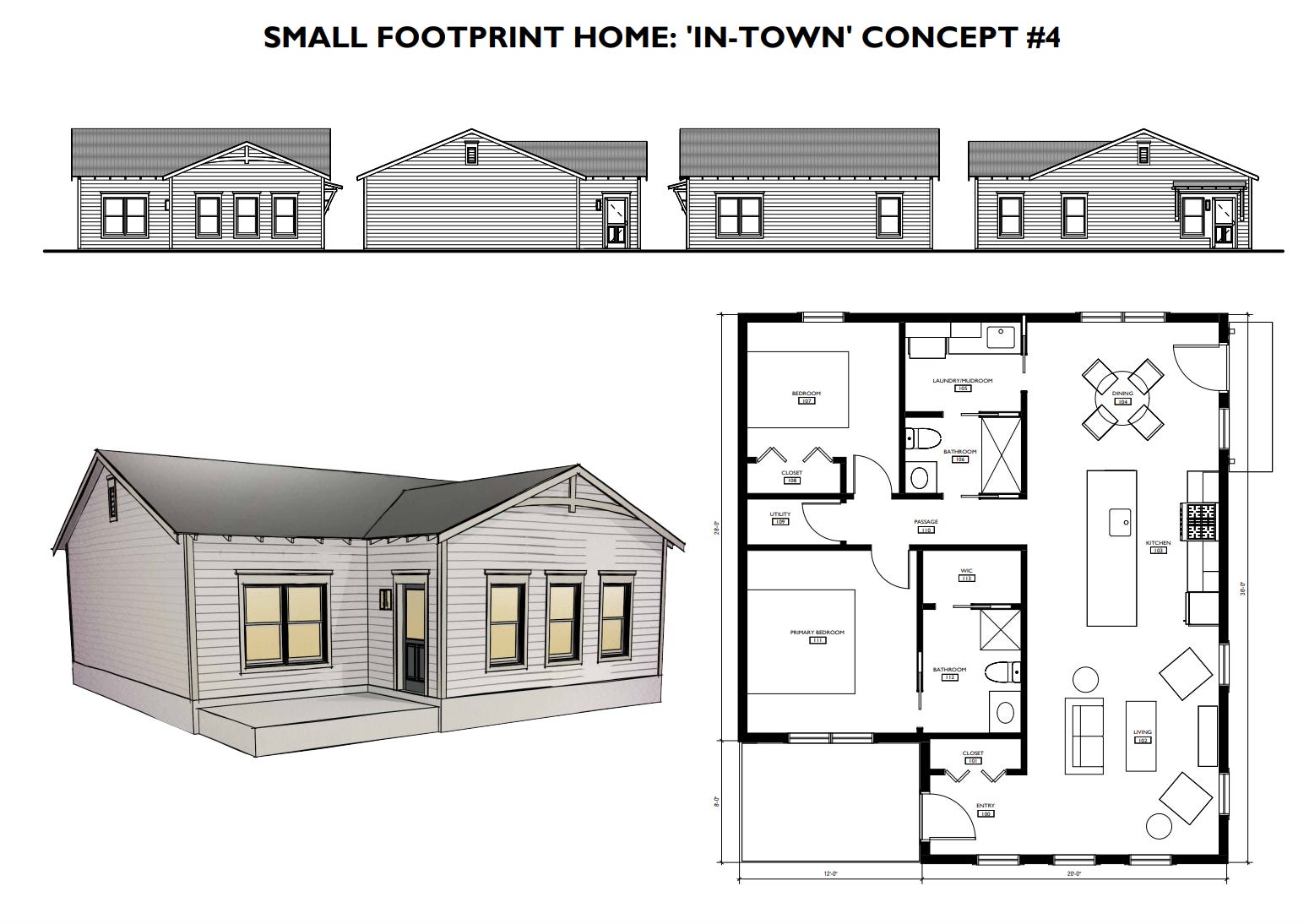
Leadership in Ottawa County has acknowledged that there are tens of thousands of households comprised of single adults, couples without children, or families with just one child at home. Some of these households will choose big homes, but many would love a smaller option if it were both available and affordable. The Small Footprint Homes Initiative strives to encourage local communities and builders to focus some of their energy on enabling these options in the community.
Note that these are NOT tiny homes. While there is a place in the market for tiny homes, its generally a very small segment of the market that is satisfied with something tiny. Small homes, however, had been roughly 30% of our housing stock throughout much of the 20th century. In the post-war building environment of the 1950s, more than half of all new homes built were 1,200 square feet or less.
From Assessment to Action: Adjusting Local Policies
Understanding your housing landscape is only valuable if it leads to meaningful response. Here’s how communities can translate assessment findings into policy action.
Aligning Zoning with Identified Needs
If an assessment reveals a shortage of smaller, more affordable housing types, communities can examine whether their zoning actually permits such housing to be built. Many communities discover that their codes effectively prohibit the “missing middle” housing—duplexes, townhomes, small apartment buildings—that would address their most pressing gaps. Adjusting use permissions and dimensional standards to allow these housing types in appropriate locations is often a logical first step.
Calibrating Incentive Programs
Communities often offer incentives like density bonuses, tax abatements, or expedited permitting to encourage desired development. Assessment findings can help target these incentives more precisely. If the data shows a particular need for workforce housing or senior-accessible units, incentive programs can be designed or adjusted to specifically encourage those types.
Informing Infrastructure Investments
Housing needs assessments often highlight geographic patterns—areas where housing could grow if infrastructure supported it, or neighborhoods where aging systems constrain development. These findings can guide capital improvement planning, ensuring that water, sewer, and transportation investments align with housing goals.
Shaping Preservation Strategies
Not all housing needs are met through new construction. Assessments frequently reveal that existing affordable housing is at risk—older apartment buildings that might convert to higher-cost uses, or manufactured home communities facing redevelopment pressure. Armed with this knowledge, communities can develop preservation strategies before these units are lost.
Setting Realistic Goals and Measuring Progress
Perhaps most importantly, a housing needs assessment gives communities a baseline against which to measure progress. Rather than vague aspirations to “improve affordability,” communities can set specific targets—adding a certain number of units in a particular price range over a defined timeframe—and track whether policies are producing intended results.
Making It Work
The most effective housing needs assessments share a few characteristics. They engage community members in defining what “need” means locally, rather than relying solely on technical definitions. They’re updated regularly—housing markets shift, and a five-year-old assessment may no longer reflect current conditions. And they’re treated as living documents that inform ongoing decision-making, not reports that sit on shelves.
When done well, a housing needs assessment transforms abstract debates about development into grounded conversations about community priorities. It helps residents see that their individual housing challenges connect to broader patterns—and that thoughtful policy responses can make a real difference.
The teacher, the retired couple, the growing family—their stories don’t have to end with frustration. A community that understands its housing needs is a community equipped to address them.
If your community is looking for a partner to conduct a housing needs assessment, or you have a recent assessment but the community is struggling to identify how to take action on the data, Flywheel is designed to help local cities and counties take concrete action and build momentum toward healthier communities. Reach out at hello@flywheelmomentum.com